[There are no radio stations in the database]

Articles

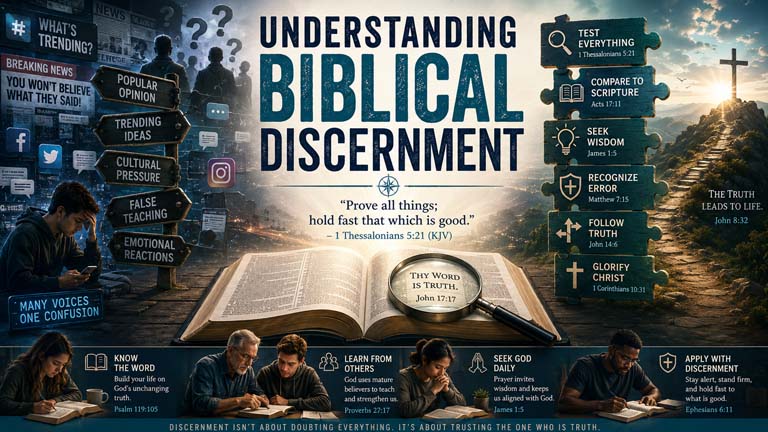
In a world filled with competing voices, endless information, and countless opinions, one of the most important skills a Christian can develop is discernment.
Every day we are confronted with messages from social media, news outlets, entertainment, influencers, teachers, friends, and even fellow believers. Some messages are helpful. Some are misleading. Some contain partial truths mixed with error.

How can we know the difference?

The Bible provides the answer through the principle of discernment.

What Is Discernment?

Simply stated, discernment is the ability to distinguish between truth and error, right and wrong, wisdom and foolishness.

Biblical discernment goes beyond human reasoning or personal preference.

It is the process of evaluating everything through the lens of God’s Word.

The Apostle Paul instructed believers:

“Prove all things; hold fast that which is good.” — 1 Thessalonians 5:21 (KJV)

Notice that Paul did not tell believers to blindly accept everything they hear. Neither did he tell them to reject everything automatically.

Instead, Christians are called to test, examine, and evaluate what they encounter.

Why Discernment Matters

We live in a culture where many ideas sound good on the surface.

Not every popular idea is true.

Not every spiritual message comes from God.

Not every teacher teaches sound doctrine.

Jesus Himself warned:

“Beware of false prophets, which come to you in sheep’s clothing, but inwardly they are ravening wolves.” — Matthew 7:15 (KJV)

False teaching rarely announces itself as false.

Most deception contains elements of truth mixed with error.

That is why discernment is essential.

A believer without discernment can easily be led astray.

A believer with discernment learns to recognize truth and avoid deception.

God’s Word Is the Standard

The foundation of biblical discernment is Scripture.

Opinions change.

Cultures change.

Trends change.

God’s Word does not.

“Thy word is truth.” — John 17:17 (KJV)

When evaluating any idea, teaching, movement, or philosophy, the first question should be:

What does the Bible say?

Not:

  • What do people think?
  • What is popular?
  • What is trending?
  • What feels right?

But:

What does Scripture teach?

God’s Word is the measuring stick by which everything else is judged.

Discernment Requires Spiritual Maturity

Discernment does not happen automatically.

Like any spiritual discipline, it develops through growth and practice.

The writer of Hebrews explains:

“But strong meat belongeth to them that are of full age, even those who by reason of use have their senses exercised to discern both good and evil.” — Hebrews 5:14 (KJV)

The more believers study Scripture, pray, and walk with God, the more they learn to recognize truth.

Spiritual maturity sharpens spiritual discernment.

Just as a skilled craftsman learns to recognize quality materials, mature believers learn to recognize sound doctrine and godly wisdom.

Discernment Is Not Suspicion

Some people mistakenly believe discernment means being critical of everything.

Biblical discernment is not cynicism.

It is not looking for faults in every person or ministry.

It is not assuming the worst.

Discernment seeks truth.

Suspicion seeks problems.

A discerning believer remains humble, teachable, and gracious while still evaluating ideas carefully.

The goal is not to become judgmental.

The goal is to become wise.

Practical Questions for Discernment

When evaluating a teaching, message, or movement, consider questions such as:

  • Does it align with Scripture?
  • Does it glorify Jesus Christ?
  • Does it encourage obedience to God’s Word?
  • What kind of fruit does it produce?
  • Does it promote truth or confusion?
  • Does it point people toward Christ or toward human personalities?

These questions help believers move beyond emotional reactions and evaluate things biblically.

The Role of Prayer

Discernment is not merely intellectual.

It is spiritual.

Believers should regularly ask God for wisdom.

James wrote:

“If any of you lack wisdom, let him ask of God.” — James 1:5 (KJV)

God delights in giving wisdom to those who seek Him.

Prayer helps believers remain sensitive to the guidance of the Holy Spirit and dependent upon God’s direction.

Discernment in the Digital Age

Never before have Christians had access to so much information.

Within minutes, a person can listen to hundreds of teachers, watch countless videos, read thousands of opinions, and join discussions with people around the world.

While this creates incredible opportunities, it also creates new challenges.

Not everything online is trustworthy.

Not every viral message is biblical.

Not every popular voice is wise.

The digital age makes discernment more important than ever.

Believers must learn to filter information through Scripture rather than allowing culture to shape their beliefs.

Conclusion

Discernment is one of the most valuable tools a Christian can possess.

It protects believers from deception.

It strengthens faith.

It promotes wisdom.

Most importantly, it helps us remain anchored to God’s truth in a world filled with competing voices.

As followers of Christ, we should not fear examining ideas.

We should simply make sure we examine them through the lens of Scripture.

May we become believers who know God’s Word, seek His wisdom, and hold fast to what is true.

“Prove all things; hold fast that which is good.” — 1 Thessalonians 5:21 (KJV)


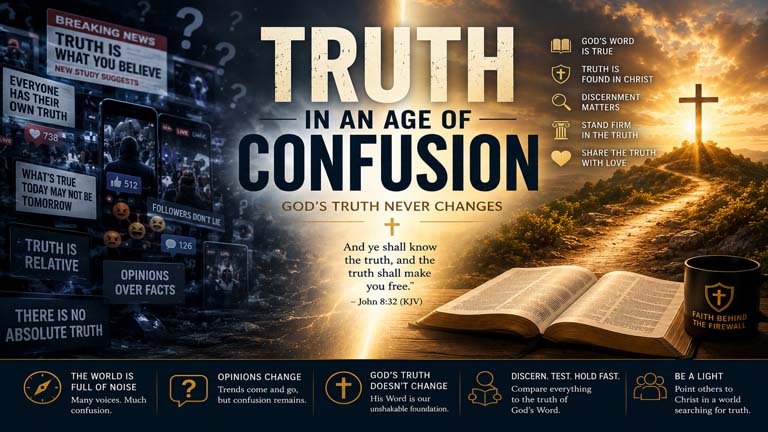
If there is one word that describes much of modern culture, it may be confusion.

People are surrounded by information, yet many struggle to find truth.

Technology has given us instant access to knowledge, opinions, and perspectives from around the world. While this has created incredible opportunities, it has also produced a flood of conflicting messages about morality, identity, purpose, and meaning.

In a world where everyone seems to have an opinion, many people are asking a simple question:

What is true?

Fortunately, God has already provided an answer.

The World’s View of Truth

Many people today believe truth is relative.

In other words, what is true for one person may not be true for another.

This mindset often sounds appealing because it appears tolerant and accepting. However, it quickly creates problems.

If truth is different for every individual:

  • Right and wrong become matters of opinion.
  • Morality becomes subjective.
  • Justice loses its foundation.
  • Meaning becomes uncertain.

Eventually, confusion replaces clarity.

When every belief is considered equally true, genuine truth becomes impossible to identify.

God’s Truth Does Not Change

The Bible presents a very different view.

Scripture teaches that truth originates with God because God Himself is truth.

“Sanctify them through thy truth: thy word is truth.” — John 17:17 (KJV)

Unlike human opinions, God’s truth does not change with culture, politics, trends, or public opinion.

What was true when Scripture was written remains true today.

God’s standards remain constant because His character remains constant.

This provides believers with a foundation that is stable in an unstable world.

Jesus Christ Is the Truth

Truth is not merely a concept.

Truth is ultimately found in a person.

Jesus declared:

“I am the way, the truth, and the life: no man cometh unto the Father, but by me.” — John 14:6 (KJV)

This statement leaves little room for confusion.

Jesus did not claim to be one truth among many.

He claimed to be the truth.

For Christians, truth is not determined by popularity or majority opinion. It is found in the person and teachings of Jesus Christ.

Why Confusion Is Increasing

Throughout history, people have wrestled with difficult questions.

What makes today’s environment unique is the sheer volume of competing voices.

Social media.

News outlets.

Entertainment.

Influencers.

Political movements.

Cultural trends.

Each offers its own interpretation of reality.

Many people spend hours consuming content every day but very little time studying God’s Word.

When Scripture is replaced by cultural opinion, confusion inevitably follows.

Discernment Matters

Because believers live in a world filled with competing ideas, discernment is essential.

Discernment means evaluating ideas through the lens of Scripture.

The Apostle Paul encouraged believers:

“Prove all things; hold fast that which is good.” — 1 Thessalonians 5:21 (KJV)

Christians should not accept every message simply because it is popular.

Nor should they reject ideas out of fear.

Instead, they should carefully compare everything to God’s Word.

Truth can withstand examination.

Truth and Compassion Must Remain Together

Standing for truth does not give believers permission to become harsh or arrogant.

Jesus demonstrated both truth and grace.

Christians are called to do the same.

We should never compromise biblical truth.

Neither should we forget that people who are confused, searching, and hurting need compassion.

Truth without love can become cold.

Love without truth becomes empty.

The Gospel provides both.

A Light in the Darkness

Confusion creates opportunities for believers.

When people are searching for answers, Christians have the privilege of pointing them toward Christ.

The world does not need more noise.

It needs truth.

The world does not need more confusion.

It needs clarity.

The world does not need more opinions.

It needs the Word of God.

“Ye are the light of the world.” — Matthew 5:14 (KJV)

Light shines brightest when darkness is greatest.

Conclusion

We live in an age filled with uncertainty and competing voices.

Yet Christians need not be overwhelmed.

God has not left us without guidance.

His Word remains true.

His promises remain sure.

His Son remains the answer.

In an age of confusion, believers can stand confidently upon the unchanging truth of Jesus Christ and help others find the hope, clarity, and purpose that can only be found in Him.

“And ye shall know the truth, and the truth shall make you free.” — John 8:32 (KJV)


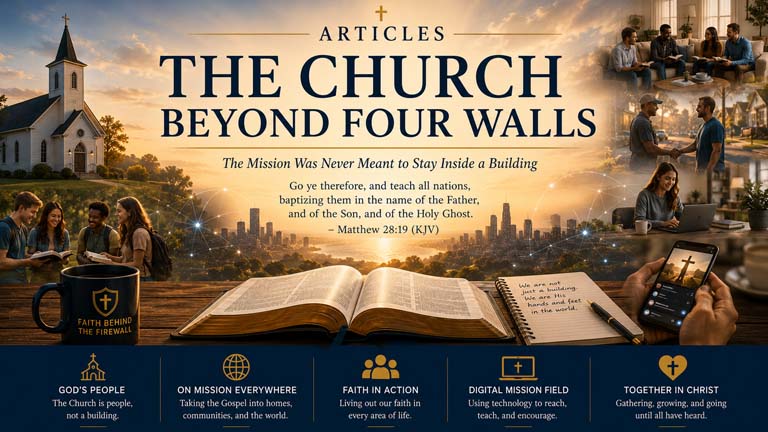
When most people hear the word “church,” they immediately think of a building.

They picture a sanctuary, pews, a stage, classrooms, and a congregation gathering on Sunday morning.

While these places are important and serve a valuable purpose, Scripture reminds us that the Church is much more than a building.

The Church is people.

It is believers united by faith in Jesus Christ, serving God together and carrying the Gospel into the world.

The Church has never been limited to four walls.

The Early Church Had No Church Buildings

Many Christians are surprised to learn that the first believers did not gather in dedicated church buildings.

The early Church met in homes, public spaces, courtyards, and wherever believers could gather together.

Their strength was not found in a structure.

Their strength was found in Christ.

“For where two or three are gathered together in my name, there am I in the midst of them.” — Matthew 18:20 (KJV)

The Church grew rapidly because believers understood that they were called to live out their faith every day, not just during scheduled meetings.

The Building Is a Tool, Not the Mission

Church buildings are blessings.

They provide places for worship, teaching, fellowship, discipleship, and outreach.

But the building itself is not the Church.

The mission of the Church remains the same whether believers meet in a sanctuary, a home, a school, a prison, a mission field, or an online community.

Jesus never commanded His followers to build buildings.

He commanded them to make disciples.

“Go ye therefore, and teach all nations.” — Matthew 28:19 (KJV)

Buildings support the mission.

They are not the mission.

Ministry Happens Everywhere

Many believers mistakenly separate their spiritual lives from the rest of their daily activities.

They view church as something that happens on Sunday.

Scripture presents a different picture.

The Church is active wherever believers are found.

At work.

At school.

In neighborhoods.

In homes.

In hospitals.

In coffee shops.

In prisons.

On mission fields.

And increasingly, in digital spaces where millions of people gather every day.

Every place where Christians live out their faith becomes an opportunity for ministry.

The Digital Mission Field

The internet has become one of the largest gathering places in human history.

People seek information, relationships, encouragement, answers, and hope online every day.

Many who would never walk through the doors of a church building may be willing to read an article, watch a video, listen to a testimony, or participate in an online discussion.

This does not replace the local church.

Rather, it creates new opportunities to extend the Church’s reach.

Technology can never replace genuine Christian fellowship, but it can help facilitate it.

It can connect believers.

It can encourage prayer.

It can share biblical truth.

It can provide support for those who feel isolated.

When used wisely, technology becomes another tool for advancing the Great Commission.

The Importance of Gathering Together

Recognizing that the Church extends beyond four walls does not diminish the importance of gathering together.

Scripture encourages believers to meet regularly for worship, fellowship, encouragement, and discipleship.

“Not forsaking the assembling of ourselves together.” — Hebrews 10:25 (KJV)

God designed believers to grow in community.

The goal is not to replace the local church.

The goal is to strengthen believers so they can carry their faith into every area of life.

The Church on Mission

The Church was never intended to remain inside a building.

It was commissioned to go into the world.

Every believer has a role to play.

Every gift has a purpose.

Every interaction is an opportunity to reflect Christ.

The mission field begins the moment we leave the church parking lot.

And in today’s world, it often continues through the devices we carry in our pockets and the communities we participate in online.

Conclusion

Church buildings remain important places for worship and fellowship.

But the Church itself is much larger than any structure.

The Church is God’s people, called to live for Christ and share His Gospel wherever He places them.

As believers, we should cherish our local churches while also recognizing that ministry extends far beyond the walls of a building.

The mission has never been confined to four walls.

It has always been about reaching people with the hope of Jesus Christ.

“Ye are the light of the world. A city that is set on an hill cannot be hid.” — Matthew 5:14 (KJV)


When many people think about ministry, they often picture pastors, missionaries, church leaders, and seasoned believers with years of experience.

While God certainly uses mature Christians in powerful ways, Scripture repeatedly shows that He also works through young people.

In fact, some of the most significant figures in the Bible began serving God while they were still young.

Age has never been a barrier to God’s calling.

God Has Always Used Young People

Throughout Scripture, we find examples of young men and women whom God used for extraordinary purposes.
David was a shepherd boy when God chose him to become king.

Samuel heard God’s voice while still a child.

Josiah became king at a young age and led spiritual reforms throughout the nation.

Mary was likely a young woman when God entrusted her with the incredible responsibility of becoming the mother of Jesus.

Timothy was considered young by many, yet Paul entrusted him with significant leadership responsibilities.

God does not wait until someone reaches a certain age before He begins working through them.

He looks at the heart.

Young People Bring Energy and Vision

Every generation has unique strengths.

Young believers often bring:

  • Enthusiasm
  • Creativity
  • Fresh perspectives
  • Willingness to learn
  • A desire to make a difference

These qualities can become powerful tools when surrendered to God.

The Church benefits when younger believers are encouraged to serve, contribute ideas, and develop their gifts.

Rather than viewing youth as a limitation, ministries should recognize the opportunities God may be providing through the next generation.

Technology Has Opened New Doors

Today’s young people have grown up in a connected world.

Many are comfortable with:

  • Social media
  • Video production
  • Graphic design
  • Audio editing
  • Web development
  • Streaming platforms
  • Digital communication

These skills can be used for far more than entertainment.

When combined with biblical truth and spiritual maturity, they become valuable tools for ministry.

The Gospel never changes, but the methods we use to share it often do.

Young believers are uniquely positioned to help ministries navigate today’s digital mission field.

The Church Needs Mentors and Builders

Young people do not need to be left on their own.

They need mature believers who are willing to invest in them.

Paul mentored Timothy.

Moses mentored Joshua.

Elijah mentored Elisha.

Throughout Scripture, we see older believers preparing the next generation for future service.

Healthy ministries do not simply focus on what God is doing today.

They also prepare for what God will do tomorrow.

When experienced believers invest in younger Christians, the impact can extend far beyond a single generation.

Your Age Does Not Determine Your Usefulness

One of the most encouraging verses for young believers comes from Paul’s instruction to Timothy:

“Let no man despise thy youth; but be thou an example of the believers.” — 1 Timothy 4:12 (KJV)

Notice that Paul did not tell Timothy to wait until he was older.

He challenged him to lead by example.

Young believers can demonstrate:

  • Faithfulness
  • Integrity
  • Compassion
  • Courage
  • Spiritual maturity

God is not limited by age.

He is looking for willing hearts.

A Generation Called to Serve

The world needs young Christians who are willing to stand for truth.

It needs young leaders who will remain faithful to Scripture.

It needs young creators who will use their talents for God’s glory.

It needs young believers who understand that ministry is not reserved for a select few, but is part of every Christian’s calling.

Whether through music, technology, teaching, missions, media, outreach, or simple acts of service, God can use young people in remarkable ways.

Conclusion

The future of ministry is not found in buildings, programs, or technology alone.

It is found in people.

As older believers faithfully serve today, they should also invest in those who will carry the work forward tomorrow.

Young people are not merely the future of the Church.

They are an important part of the Church right now.

May we encourage them, equip them, mentor them, and give them opportunities to serve so that God may continue His work through the generations to come.

“Let no man despise thy youth; but be thou an example of the believers.” — 1 Timothy 4:12 (KJV)


Every generation faces challenges that test its convictions.

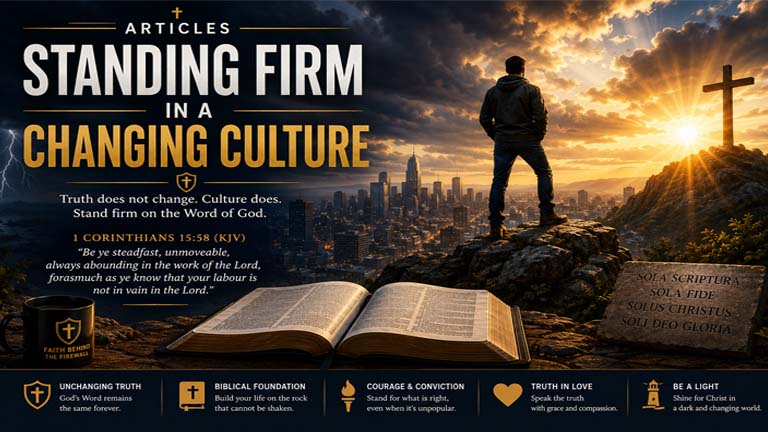
Today, believers find themselves living in a culture that seems to change at an increasingly rapid pace. Values that were once widely accepted are questioned. Truth is often treated as subjective. Biblical principles are frequently challenged, misunderstood, or rejected altogether.

In such an environment, Christians may feel pressure to compromise their beliefs in order to fit in, avoid criticism, or gain acceptance.

Yet Scripture repeatedly calls believers to stand firm.

The World Has Always Changed

While modern challenges may seem unique, God’s people have faced similar struggles throughout history.

Noah lived in a corrupt generation.

Daniel served in a pagan government.

The early church faced persecution from both religious and political authorities.

The Apostle Paul ministered in cultures filled with idolatry, immorality, and false teachings.

Despite these challenges, God’s people were called to remain faithful.

The circumstances may have changed, but the calling remains the same.

Our Foundation Must Be God’s Word

When everything around us seems uncertain, we need a foundation that does not move.
Jesus taught this principle in His parable of the wise and foolish builders.

“Therefore whosoever heareth these sayings of mine, and doeth them, I will liken him unto a wise man, which built his house upon a rock.” — Matthew 7:24 (KJV)

Culture changes.

Opinions change.

Trends change.

God’s Word does not.

When believers build their lives upon Scripture, they possess an anchor that remains secure regardless of the storms around them.

Standing firm does not mean refusing to learn or grow. It means measuring every idea, belief, and cultural trend against the truth of God’s Word.

Standing Firm Requires Courage

There are times when following Christ requires courage.

The Apostle Paul wrote:

“Watch ye, stand fast in the faith, quit you like men, be strong.” — 1 Corinthians 16:13 (KJV)

Standing firm is often easier in theory than in practice.

It may mean:

  • Defending biblical truth when it is unpopular.
  • Refusing to compromise personal convictions.
  • Showing integrity when dishonesty would be easier.
  • Remaining faithful when others walk away.
  • Choosing obedience over approval.

Christ never promised that following Him would always be easy.

He did promise that He would be with us.

Truth and Love Must Walk Together

Standing firm does not mean becoming harsh, argumentative, or unkind.

Unfortunately, some people view conviction and compassion as opposites.

Scripture teaches otherwise.

Jesus was full of both grace and truth.

Believers are called to speak the truth, but to do so in love.

“But speaking the truth in love, may grow up into him in all things, which is the head, even Christ.” — Ephesians 4:15 (KJV)

The goal is not to win arguments.

The goal is to point people toward Christ.

Firm convictions should always be accompanied by humility, patience, and genuine love for others.

Our Hope Is Not in Culture

It is easy to become discouraged when looking at the condition of the world.

News headlines often highlight division, confusion, violence, and uncertainty.

Yet Christians should remember that our hope has never been found in culture, politics, or public opinion.

Our hope is found in Jesus Christ.

The Kingdom of God is not dependent upon the latest trends or cultural movements.

Christ remains on the throne.

His truth remains unchanged.

His Gospel continues to transform lives.

Because of this, believers can stand firm with confidence, knowing that God is still at work.

Be a Light in the Darkness

Rather than retreating from the world, Christians are called to shine within it.

Jesus said:

“Ye are the light of the world. A city that is set on an hill cannot be hid.” — Matthew 5:14 (KJV)

Light is most noticeable when darkness is present.

As culture changes, believers have an opportunity to demonstrate faithfulness, integrity, kindness, and truth in ways that point others toward Christ.

The answer to a changing culture is not fear.

The answer is faithful obedience.

Conclusion

Every generation must decide where it will stand.

The pressures may be different.

The challenges may evolve.

But God’s truth remains the same.

As followers of Jesus Christ, we are called to stand firm upon His Word, speak truth with love, and live in a way that reflects His character.

In a changing culture, our confidence is not in ourselves.

Our confidence is in the unchanging God who has promised never to leave us nor forsake us.

“Be ye steadfast, unmoveable, always abounding in the work of the Lord.” — 1 Corinthians 15:58 (KJV)


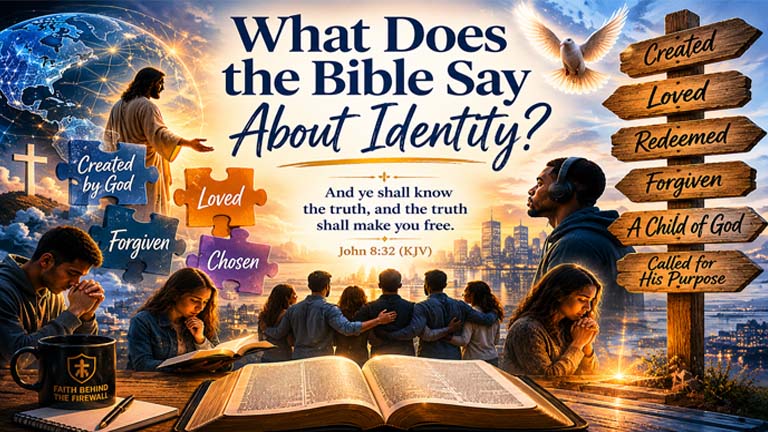
Few questions are more important than this:

Who am I?

For generations, people have wrestled with questions of identity, purpose, and belonging. Today, these questions are more common than ever. Social media, popular culture, politics, and countless online voices offer competing answers about who we are and how we should define ourselves.

Yet long before modern culture began debating identity, God had already spoken clearly through His Word.

If we want to understand our identity, we must begin with the One who created us.

We Are Created by God

The Bible teaches that every human being is intentionally created by God.

“So God created man in his own image, in the image of God created he him; male and female created he them.” — Genesis 1:27 (KJV)

Our identity does not begin with our feelings, achievements, possessions, or popularity. It begins with God.

Every person possesses inherent value because they are made in the image of their Creator. This truth applies to every race, nationality, age, and background.

Because we are created by God, our worth is not determined by what others think of us. Our value comes from the One who made us.

We Are More Than Our Occupation

Many people define themselves by what they do.

They may say:

  • I am a teacher.
  • I am a business owner.
  • I am a student.
  • I am an engineer.
  • I am a pastor.

While our occupations are important, they are not our ultimate identity.

Jobs change.

Careers end.

Titles come and go.

Our identity must be rooted in something greater than temporary accomplishments.

When our identity is built entirely upon our work, we can become discouraged when circumstances change. But when our identity is grounded in God, it remains secure regardless of success or failure.

We Are More Than Our Past

Some people define themselves by their mistakes.

They carry guilt from previous decisions and believe they will always be identified by their failures.

Yet Scripture tells a different story.

Consider the Apostle Paul.

Before becoming one of Christianity’s greatest missionaries, Paul persecuted believers and opposed the Church. Yet God transformed his life and used him powerfully.

“Therefore if any man be in Christ, he is a new creature: old things are passed away; behold, all things are become new.” — 2 Corinthians 5:17 (KJV)

For those who place their faith in Jesus Christ, the past does not define the future.

God’s grace is greater than our failures.

Our True Identity Is Found in Christ

The most important identity a believer can possess is not found in a career, hobby, political affiliation, or social status.

It is found in Jesus Christ.

When a person trusts Christ as Savior, they become a child of God.

“But as many as received him, to them gave he power to become the sons of God, even to them that believe on his name.” — John 1:12 (KJV)

This changes everything.

A believer is:

  • Forgiven.
  • Redeemed.
  • Loved.
  • Adopted into God’s family.
  • An heir of eternal life.
  • A new creation in Christ.

These truths remain constant regardless of circumstances.

The world may change its standards and definitions, but God’s promises never change.

Finding Identity in a Confused World

We live in a time when many people are searching for identity in temporary things.

Some look to wealth.

Others seek approval from friends, followers, or society.

Still others search for meaning through personal achievement.

Yet none of these things can fully satisfy the deepest needs of the human heart.

Only Christ can do that.

When we understand who God is and who we are in relation to Him, we discover a foundation that cannot be shaken.

Our identity is not determined by culture.

Our identity is not determined by public opinion.

Our identity is not determined by our successes or failures.

Our identity begins with our Creator and is fulfilled through a relationship with Jesus Christ.

Conclusion

The world offers countless answers to the question, “Who am I?”

The Bible provides a clear and lasting answer.

You are created by God.

You are loved by God.

And through faith in Jesus Christ, you can become a child of God.

In a world filled with confusion, uncertainty, and changing definitions, believers can rest confidently in the truth that their identity is found not in themselves, but in Christ.

“And ye shall know the truth, and the truth shall make you free.” — John 8:32 (KJV)


  • Pages

  • 1
[There are no radio stations in the database]